Happy Birthday,
Route 66
Story and photos
by Kathleen Walls
You're 100 years old this year and I have many
happy memories of traveling along you.
Here's a recap of some of my favorites.

There's a
small free museum in
a county library in Lebanon, Missouri that tells Route
66's story. It took me back to the earliest days
of Route 66.
The first exhibit is Philcheck
Service Station. The
station sports Fire Chief and Skelly gas pumps. A
uniformed attendant is coming out to service the Ford
Roadster sitting at the pumps. I still
foindly remember the
days when an attendant came out and said "Fill 'er up?"
then wiped your windshield, checked your oil and the
pressure in your tires .
Of course, as the route became
more traveled, tourist courts and diners sprang up along
Route 66. The exhibit of a typical tourist
cabin from the 1940s is nostalgic. I love the chenille
bedspread. Once you saw them all over now they are
antiques and more expensive than when new. Mark
explained how much of their exhibits are dependent on
donations. The Knotty Pine paneling came from the Best
Western Wyota Inn, the desk is from Nelson's Dream
Village.
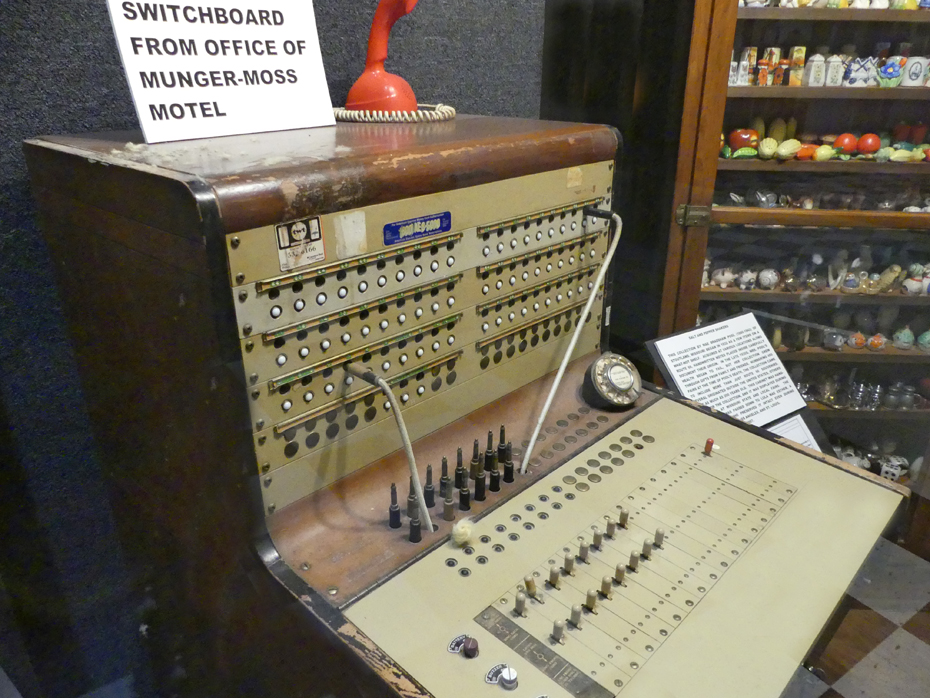
Communication with the desk was
easy then. An operator was usually on duty at a
switchboard to handle you calls. This one came from the
Munger Moss Motel which is still in business. In the
background is a portion of a Route 66 salt and pepper
collection. That harkens back to the day when
restaurants still put salt and pepper shakers on the
table and you didn't have to beg for one. Chef's and
cooks didn't get insulted by that. They knew people
weren't robots all liking the same amount of seasonings
the chef put.
Everyone had individual tastes those days.
Diners have remained to this day
and are reminiscent of the time when travelers
fell in love with the open road. There were no chains and fast food
joints. Nicely tiled floor and a counter with vinyl
covered stools and plenty of Formica and chrome greeted
you. Your friendly waitress was usually wearing a pastel
cotton dress with a white apron. The food was always
plentiful and freshly cooked. Naturally there was a
jukebox where you could listen to Elvis, Frank or Hank
while you waited for your meal. Or perhaps you spent the
time whacking a pinball machine on its sides trying to
make that little ball go where you wanted.
One exhibit displays a
Goodroads Map as signage wasn't as good those days and
there was no Google to tell you every step of your trip.
There is so much more in this
little museum and Mark Spangler former curator
told us, "It was a different
world. The frugality and inventiveness of our family
businesses, I'm finding a lot of recycling. You find
Victorian furnishing. They used what they had. They
didn't spend a half a million dollars on buying a
franchise to a cookie cutter brand. It was totally
unique but they cared about service and while you were
there you were taken care of. The concept of uniqueness
is almost gone."
Chicago
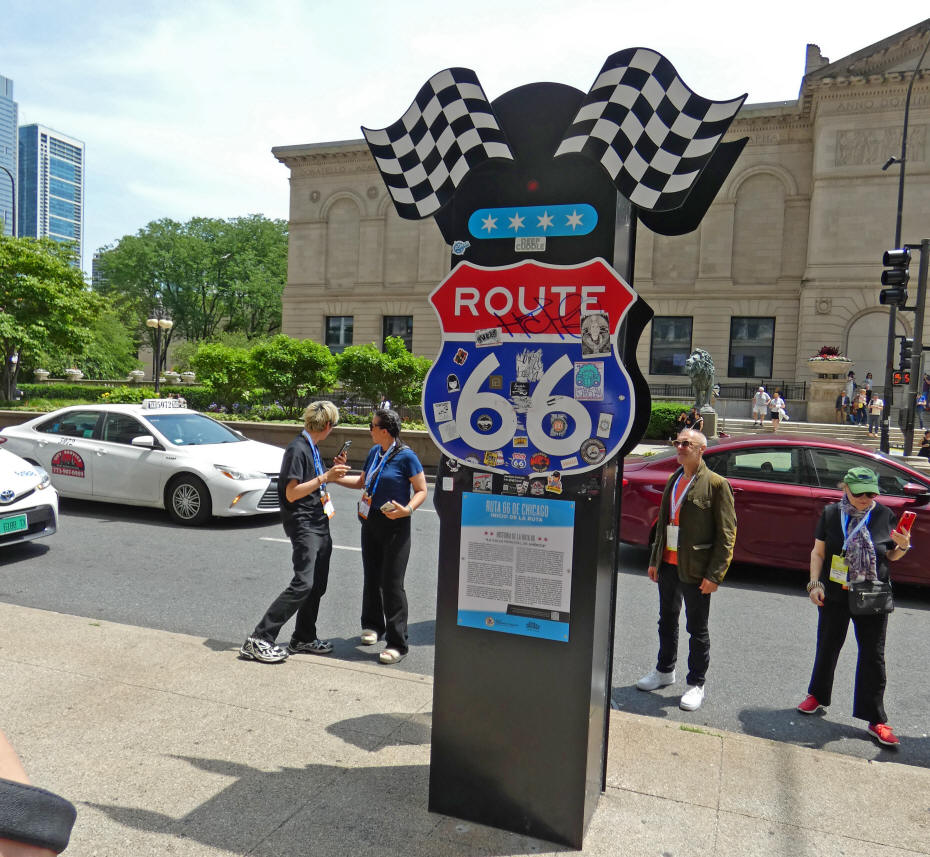
Although most people associate Route 66
with the wide open spaces out west, Route 66 started in
Chicago in 1926
and ran through
Illinois, Missouri, Kansas, Oklahoma, Texas, New Mexico, Arizona
and California. Originally, the start was at the intersection of
Jackson Boulevard and Michigan Avenue, but the marker for the
start is now at East Adams and South Michigan Avenue
intersection, as Jackson is now an east-bound one-way street.
(Blame Chicago traffic!)
Our guide, Mike McMains, drove us along a
tour of Chicago's Route 66.
Mike stopped the trolley or let us get out
at important stops on Route 66 when traffic and parking allowed.
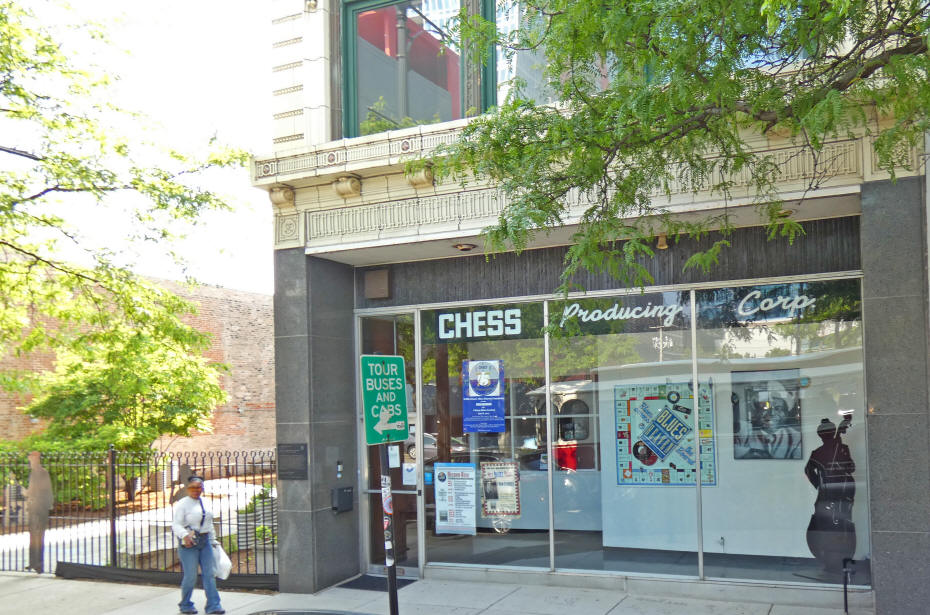
One place on Route 66 that impressed me is
Chess Productions,
where Muddy Waters, Etta James, Bo Diddley, Chuck Berry, one of
my favorites, and many other musicians recorded. It's now a
museum.
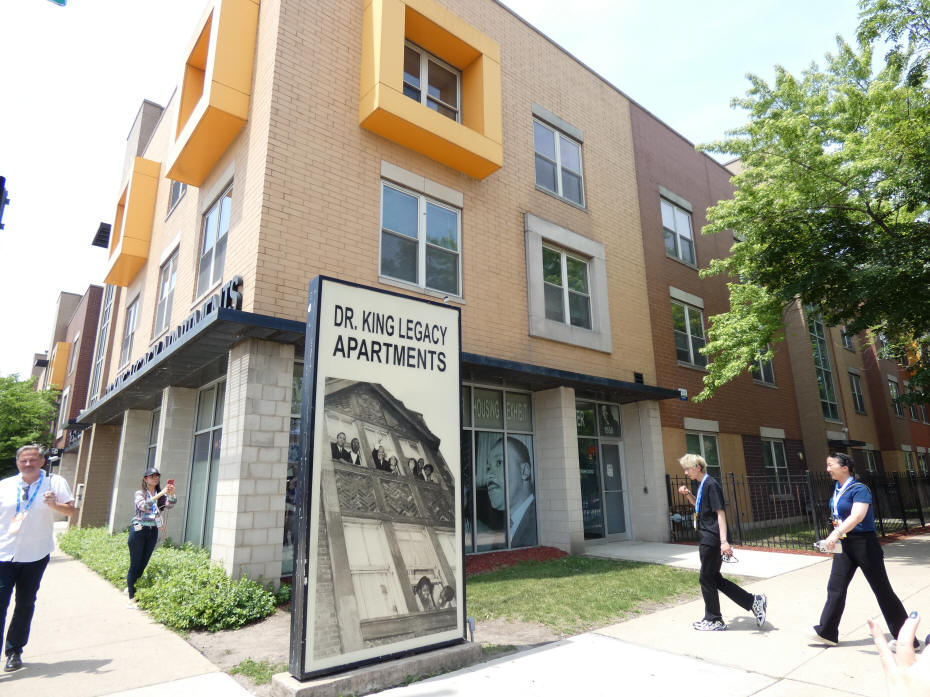
Another important stop just off the
historic route is the
Martin Luther King Jr. Legacy Apartments.
The story behind the apartments is that this was once an area of
poor Black residents. Housing markets, like many other things,
were badly skewed against Black people in Chicago. Dr. Martin
Luther King, Jr. came to Chicago in the winter of 1966 to raise
awareness about housing restrictions on Chicago's black
residents. He rented an apartment at this location.
During the riots after King's death, much
of that apartment complex was destroyed. Later, civil rights
groups proposed a housing complex as a memorial to Dr. King's
civil rights legacy to provide badly needed affordable housing
to North Lawndale. By April 2011, it was still one of Chicago's
poorest neighborhoods.
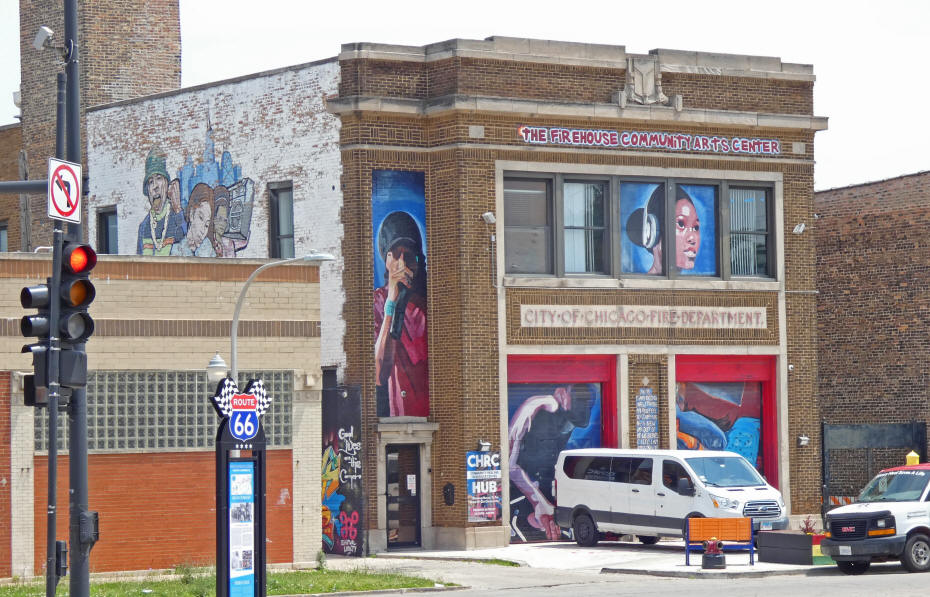
Nearby, the
Firehouse Community Arts
Center, is a hub for youth from across the city, dedicated to
preventing violence through arts and community engagement. The
historic firehouse has several murals decorating the building
and helping tell its story.
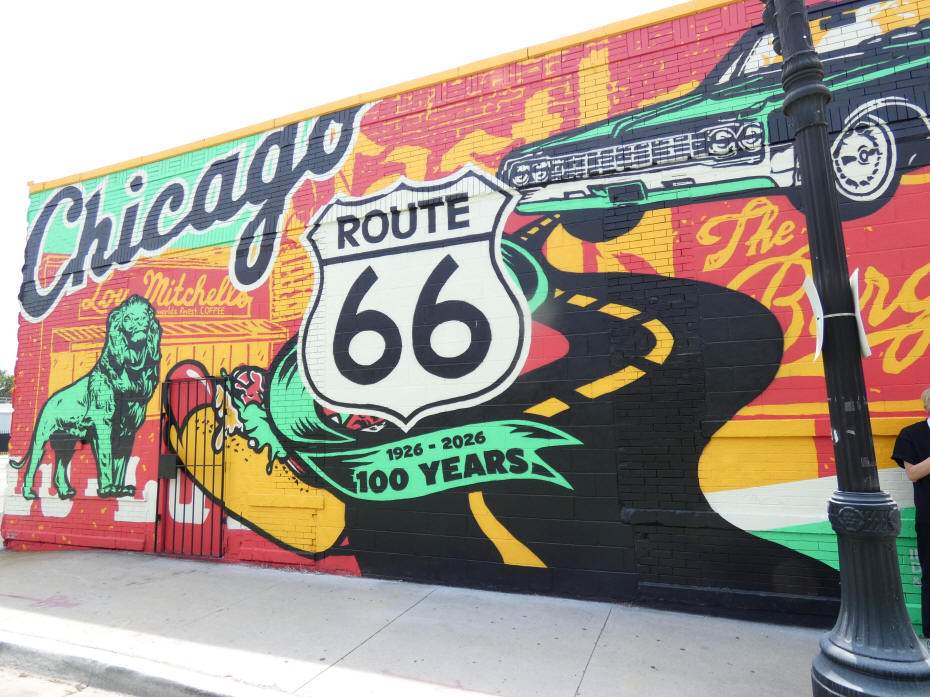
The Firehouse Center is not the only place
to find murals on Chicago's Route 66. I love the one
commemorating Route 66's coming 100-year anniversary in 2026 by
local artist Ben Marasco. It features several local businesses
along the route: Art Institute of Chicago, Lou Mitchell's, The
Berghoff Restaurant, and Lulu's Hot Dogs where it is painted at
1000 S. Leavitt St.
Missouri
Red Oak II

Followering Route 66 through Missouri is a
step back in time. The U.S. is full of deserted ghost
towns, places abandoned when jobs ran out and residents moved to
larger cities in search of work. But sometimes ghost towns can
be reincarnated. Such is the case in
Red Oak II near Carthage,
Missouri, one of my favorite stops along Route 66.
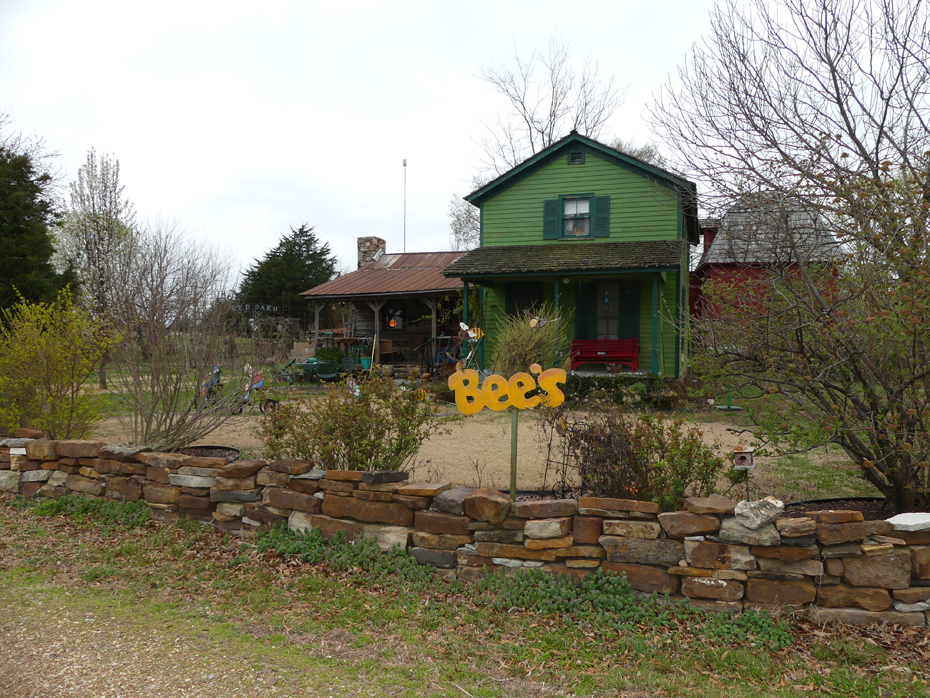
Artist, Lowell Davis best known for
his farm life folk art, grew up in Red Oak. His art
career took him far away on the road most traveled. When he returned to his home town, it was no
more. In the years he was chasing his dream, Red Oak had
become a ghost town.
But artist are creators. If
something they love is taken away, they recreate it.
That's what Red Oak II is. Lowell Davis began buying the
rundown houses, the old gas stations, the country
churches of his old home town. He moved it here and
restored them to the way he remembered them being in the
1920s through 1950s. His home now wasonce Bell Starr's
home.
Along the way, as money ran out,
Larry Frickenschmidt and his wife, Lois, stepped in to
aid in completing Lowell's dream. Larry explained his
love for the Red Oak II project. "I
grew up about two miles from here. I
have an association with Red Oak. When I was a little
kid, my mom and dad owned a store at Grays Point and
Grays Point was in direct competition with Red Oak."
Rail Haven Motel
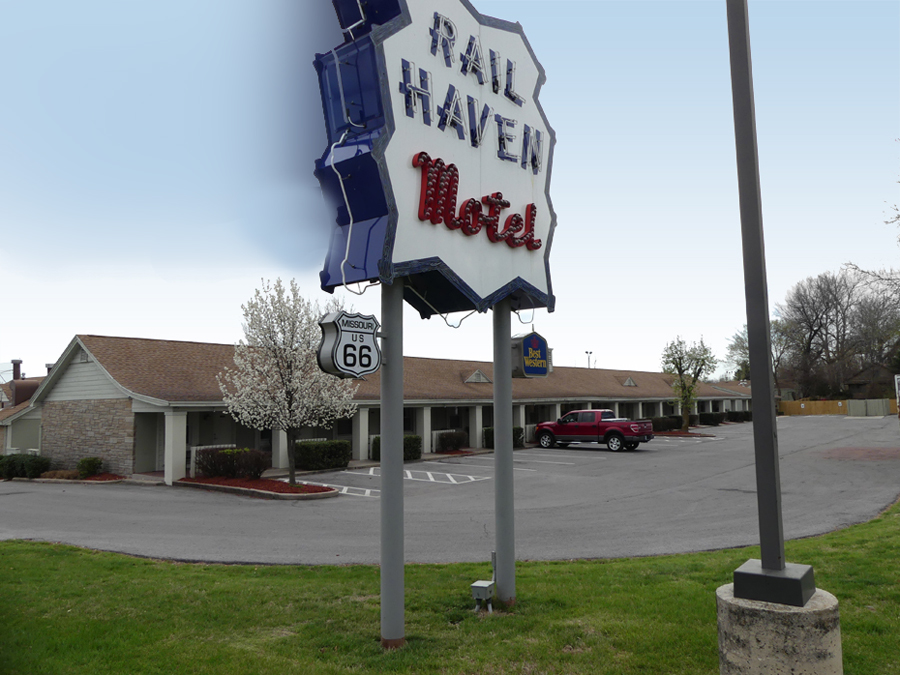
Back when a Model T was the height of
fashion for road trippers, it was only natural that new
highways sprang up around the country, Route 66 being the
most famous then and still a roadtrippers dream. John Steinbeck called it "the
Mother Road" in Grapes of Wrath. It offered a way for people
living in the small towns and cities on its route to earn a
living. They opened tourist attractions, restaurants, and
motor courts.
The motor courts were the lifeblood of the new Route 66.
Travelers needed a place to stay. A few are still alive and
flourishing.
Rail Haven Motel opened in 1938, the
same year Route 66 was officially finished, with eight
sand-colored cottages.
This was the same year Civilian Conservation Corp
youth completed the last of the paving.By 1946, Rail Haven
expanded to 28 rooms, the same year Texas hotelier M.K.
Guertin formed the blanket group of independent hotels today
known as
Best
Western.

Rail Haven was popular and several
celebrities stayed there. Loretta Young was one "big name"
guest but Rail Haven's most famous guest came almost
accidentally on May 17, 1956. Elvis Presley played the
Shrine Mosque that day and got into an argument with this
band after the show. Instead of staying in the same hotel
with them after that. He left the upscale Kentwood Arms and
walked down St. Louis Street where he saw the Rail Haven. He
checked in and stayed in room No. 409, now called the Elvis
Suite. Today, furnished with a pink Cadillac-themed bed and
Elvis photos.
No lodging can live on past fame.
When I visited Rail Haven, I was impressed with the decor.
It wasn''t fancy but it fit its theme. What I saw was a motor
court of the 1960s but upgraded with modern amenities
including WIFI and quiet air conditioning. I had a
mini-fridge, a microwave, and a coffeemaker that worked for
my tea. The art on the walls showed the era from which Rail
Haven evolved. There are suites if you need more room and a
business center if you need a workspace.
Oklahoma
Oklahoma City sits right in the middle of
the Oklahoma stretch of Route 66 and is filled with treasures I
discovered and probably many more I did not have
time to visit.

My stay began at the historic 21C Museum
Hotel that is now known as
The Fordson Hotel. This early 1900s building earned its place on the
National Register of Historic Places by being a former Fred
Jones Ford Motor Company assembly plant that crafted Model Ts.
The hotel is a 5 star one and the art museum which is an
integral part of the hotel is unique and fantastic.

The
Centennial Land
Run Monument commemorating the opening of the Unassigned Land
in Oklahoma Territory with the Land Run of April 22,1889. It
was probably the largest group of people that had assembled up
to this time in the U.S. It''s a city
park that''s open to the public year around. There is a
beautiful walkway on both sides of the sculpture.
The
monument consisting of 47 statues, the largest series of
sculptures in the world, spans a distance of 365 feet.
They begin with the cannon and man who fired it to
start the run. Then
there are the people, horses, three wagons, a cannon, a dog,
and even a jackrabbit rushing to get out of the stampede.
All are cast in dark bronze, at one-and-a-half life
size. The detail is so realistic. The artist, Paul Moore''s,
great-grandfather participated in the Land Run.

National Cowboy and Western Heritage Museum was my favorite.
If you are an art lover, you will love it. If you are a
history lover, you will love it. If your inner kid longs to go
back to the thrilling days of yesterday and ride the range
with Roy and Gene, you will love it. Movie fans will thrill to
seeing the old Clint Eastwood Spaghetti Westerns.

Prosperity Junction is a recreated frontier village. You can
visit the schoolroom, banks and many other buildings that made
a town in Oklahoma's early years. .
Native
American culture is not ignored either. In short, it has
something for everyone.

Oklahoma History Center is another must see. It takes you
through the state''s history from the Native Americans to
present day. There''s the steamboat era, commerce, warfare, and
even the musical Oklahoma represented here.

For
something a bit different, I visited the
American Banjo
Museum. It is filled with some of the most beautiful and rare
instruments I have ever seen. There is a lot of background on
players and the history of the banjo. It portrays its humble
beginnings in the cabins of the enslaved people playing on
southern plantations. On to modern day from Earl Scruggs who
along with his partner, Lester Flatt, played the iconic theme
song for The Beverly Hillbillies, to jazz and folk singers who
played the instrument.

Oklahoma City is filled with interesting
places to visit. There is one that is not a fun quest but do
not pass it by without stopping.
The Oklahoma City National
Memorial Museum walks you through one of the most horrific
acts committed in modern history. It takes you minute by minute through the events on April 19,
1995 when a home-grown terrorist took the lives of 168 innocent
people, 19 of whom were children, in the bombing of the
Alfred P. Murrah Federal Building.
The Memorial Museum is in the former
Journal Record Building located on the corner next to where
the federal building once stood. The Journal Record for the
most part withstood the bombing. Today it retells the story of
that day so it will never be forgotten. It's the little things so often overlooked that are most
poignant, the crumbled rubble all around, yet a filled coffee
pot that remained on a table almost untouched. A briefcase found
amid the rubble belonging to a woman is displayed making you
wonder what was inside that briefcase that had brought her to the
federal building--and her death--that fateful day.
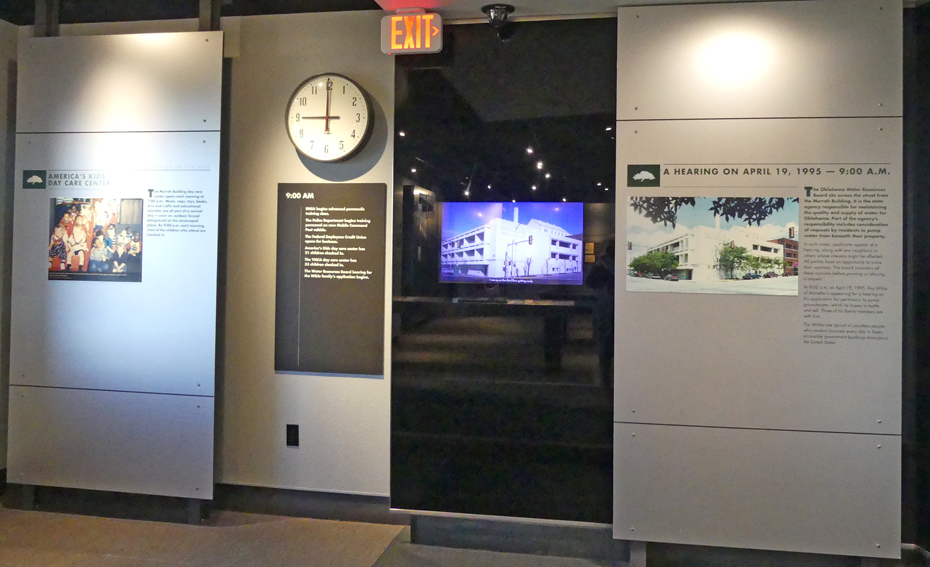
You enter and find yourself at the start
of everyday business in Oklahoma City. The Murrah Federal
Building is opening for business. Officials have returned from
a prayer breakfast where ironically the keynote speech was
"Pray for Those in Authority." Everything was boringly normal.
Yet, the museum shows that there were
clues. In March of 1993 when the Waco Standoff occurred, a
young journalism student from Southern Methodist University,
Michelle Rauche, went to Waco. She had no press credentials
but got her story by interviewing people at the scene.
One
person she
interviewed was a young man who told her, "The government is
afraid of the guns people have because they have to have
control of the people at all times. Once you take away the
guns, you can do anything to the people. You give them an inch
and they take a mile. I believe we are slowly turning into a
socialist government. Government is continually growing bigger
and more powerful, and the people need to prepare to defend
themselves against government control." That young man was
Timothy McVeigh. It was no coincidence that the Oklahoma City
bombing occurred on the second anniversary of the end of the
Waco Standoff.
There are artifacts retrieved from the
wreckage, photos, informational placards and interactive
exhibits that tell the story of an event that should never be
forgotten. There are photos of the Federal
building and adjoining buildings as they were at 9AM that
morning. The YMCA Day Care had 53 kids present; America's Kids
Day Care had 21. Emergency Medical Services Authority had
begun a
class on paramedic training. The Employee Credit Union
opened its doors. Just another day. Two minutes later all Hell
broke out.
Texas
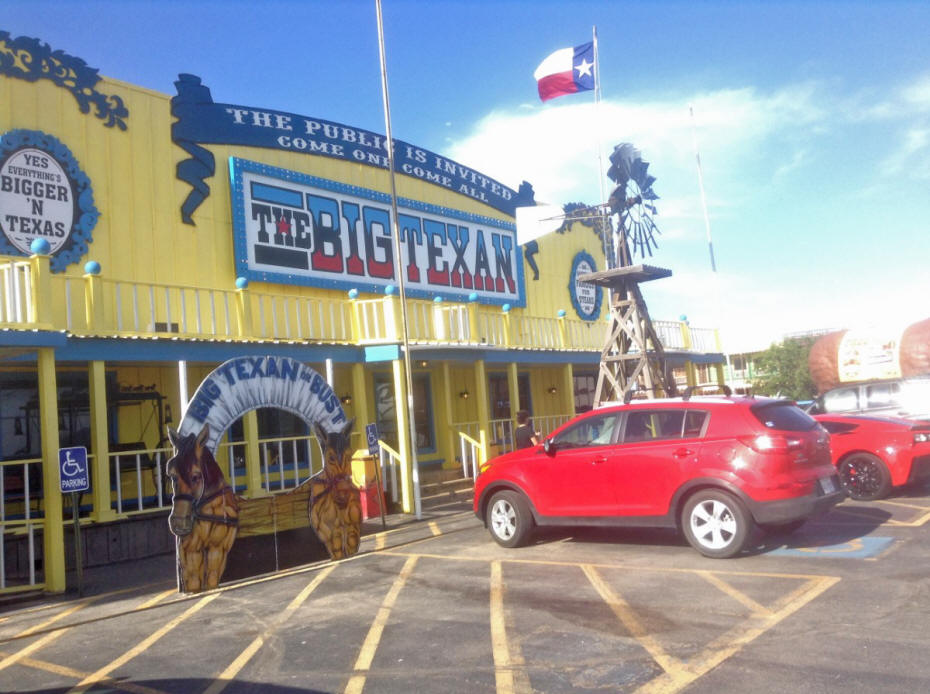
It's fun and food wrapped in one gaudy
package. If Miss Kitty had a dinner date with Marshal Dillon,
The Big Texan Steak Ranch in Amarillo is where they would dine.
Before you enter, the quirky decor
yells "fun." The building is Western Movie Set, bright yellow
with a blue and red sign informing you that you have arrived at
The Big Texan. Lots of Texas Style folk art decorate the wide
porch and parking lot; a life sized windmill, cowboy
paraphernalia, wooden swings and benches. A huge plastic bull
sits out front with a sign proclaiming "Free 72 Ounce Steak."
(more about that steak later.)
Step in the door and you are surrounded by
even more of the same as you wander towards the back patio area
you pass fake slot machines, a party of the undead gathered
around a table, a Texas jail, a red full sized stagecoach, a
ring toss game along the back fence and lots of other fun items.
Owners, Danny and Bobby Lee chatted with us
over drinks and some tasty appetizers. The Fried Mozzarella
Cheese Stix and the Baby Back Rib Sampler were my favorites but
the Howlers AKA Blazin' Saddles (deep fried jalapenos) and the
Fried Mushrooms were nothing to pass up either.
However, since this is a steak restaurant,
and a darn good one in spite of–or because of all the fake
doodads–let's talk about that free steak and steak in general.
I
had an eight ounce Big Texan Top Sirloin with sides of baked
potato and salad. It was cooked exactly as I ordered it and
delicious. When our server, Mack, brought our order, he had us
all cut into and test our steak to be sure it was right. The Big
Texan wants everybody to be happy with their food. They must be
doing something right since they have been in business for the
past 55 years. Back in 1960, R. J, Bob Lee opened his steak
house on the Mother Road, Route 66, and began the tradition two
of his sons carry on today.
In 1970, he realized that the new highway,
Interstate 40, was going to divert much of the traffic on
historic Route 66. He moved the restaurant with all its gaudy
signs and decorations there and continued to prosper.
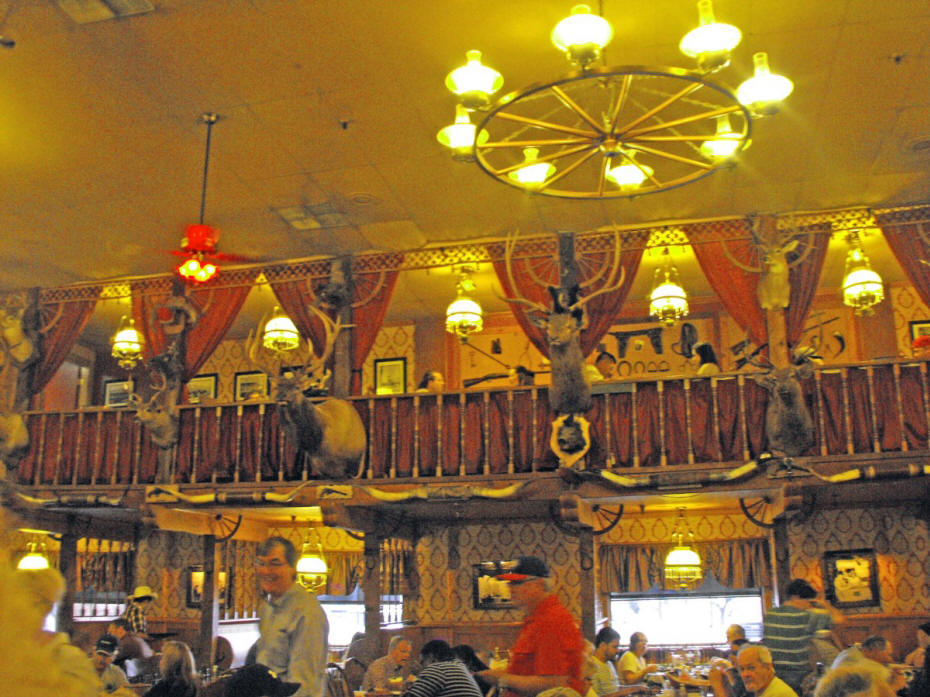
The dining room decor is more classic Old
West, wagon wheels, mounted animal heads, revolvers, imitation
gas lights, a mural of mountains with an Indian teepee in the
middle. The upstairs balcony tables have red drapes at every
post. It is a really big room and was packed the night we
visited.
A
very talented group of musicians in cowboy dress wander between
the tables playing requests. It's a scene right out of
Gunsmoke.
Naturally I had to hear
"Amarillo by Morning."
We sat up front downstairs two tables away
from the massive grill where two grillers are turning out steaks
at the speed of light. Between us and the grill sat a raised
stage set with a table prepared for any challengers who are
ready to take on "the free 72 ounce steak."
This gimmick is what put The Big
Texan on the map. Bob Lee began it
soon after opening the
original restaurant. He offered a 72 oz steak with all the
trimmings for free if you could eat it all in one hour. Since
its inception,
around 30,000 people have taken the Big Texan's 72 ounce steak
challenge but only 4,800 people have succeeded.
But the most spectacular win was when competitive eater, Molly Schuyler, wolfed down
three of the 72 ounce steaks accompanied by salads, baked
potatoes, shrimp cocktails, and rolls in 20 minutes. She broke
all records and won a grand prize of $5000.
As if the restaurant isn't spectacular
enough, Bobby and Danny also have an onsite brewery where Danny
and brewmaster Tom Money brew up 11 unique beers. And then
there is the motel just across the street. It is designed
to look like an old western town. Again look for Miss Kitty and
Marshal Dillon to check in after dinner. If they have enough
energy left after their meal, they can take a dip in the motel
poll shaped like the state of Texas. They even have a "Horse
Motel" where Dillon can stable Old Buck.
New Mexico
Santa Fe: The City Different
.JPG)
Santa Fe was my first New Mexico stop on Route 66. It
is known as "The City Different" and it really is.
A great way to get the
feel of it is to stay in a home instead of a hotel. I used
Glamping Hub to locate
Two Casitas vacation rental. My stay is
over a hundred year old. It's an adobe dwelling that epitomizes
Santa Fe. The casita is a
studio with a separate kitchen and bath and it has everything
needed for a great stay including a warm gas-lit cast iron stove
type heater.
One plus is that it is about three-quarters
of a mile from the Plaza and even less to Canyon Road. Much of
Santa Fe's culture revolves around those two places. A majority
of the city's historical sites and museums are on or near the
Plaza. Canyon Road is a doorway to Santa Fe's art world.
.JPG)
If you prefer a hotel,
La Fonda is the only hotel on the Plaza. It was the first
hotel in Santa Fe. The present day building was built in 1922
and is as much a museum and art gallery as a fine hotel. In
fact, art is so important to La Fonda they have an
artist-in-residence in the lobby Thursday through Saturday.
There are unique art works throughout the hotel and in each
room. Each headboard is hand painted by a Native American
artist. Bed runners have the look and feel of a native woven
fabric. Cabinets are decorated with native carvings and
elaborate tin work.
In
1925, Fred Harvey took over management. He owned a chain called
the Harvey Houses famous for the well-trained waitresses known
as Harvey Girls.
La Plazuela Restaurant in the hotel maintains some of the
hotel's original features. It was an open area. Today, it has a
skylight and hand-painted windows but is enclosed. The
chandelier is gorgeous. Food is excellent.
.JPG)
The Romanesque Revival style
Cathedral Basilica of
Saint Francis of Assisi
was built between 1869
and 1886 on the site of an older adobe church. Above the altar
is the San Damiano Crucifix, a replica of the crucifix in
Assisi, Italy. Behind it, you see a mural of saints of the New
World.
Three statures grace the front grounds.
There is a statue of St. Francis, the patron saint of the
diocese, installed in 1967. To the left of St. Francis is Saint
Kateri, the first Native American to be canonized. The statue
was installed in August 2003. To the right side of the walkway
is Father Lamy, first Bishop of the Diocese of Santa Fe. He is
buried in a crypt underneath the Cathedral floor .
.JPG)
A good starting point is
The New Mexico History
Museum. It
covers New Mexico's 400-plus years from earliest days of Native
Americans to the atomic age and space exploration.
Once you step inside past the covered wagon
out front you view in rich detail, clothing, weapons, tools and
art of the natives and those of the Spanish conquistadores,
missionaries and settlers. You follow New Mexico's struggles as
it became free of Spain and part of the Republic of Mexico in
1821.
See the journey of six Missouri traders
with mules laden with trade goods who took advantage of Mexico's
open borders for commerce and blazed what became the Santa Fe
Trail.
There are some interesting exhibits on the
Mexican American War which ended with us taking over New Mexico.
Some views were not like the "Remember the Alamo" version of
history we learned through the movies. Neither are the outlaws
and heroes of the old west.
The coming of the railroad began a new era
for New Mexico. There is a section dedicated to Fred Harvey and
the Harvey Girls.
The museum moves into the Atomic Age with
information on Robert Oppenheimer and Los Alamos. There are
exhibits of an atomic bomb assembled at Los Alamos. There is a
bomb at the museum similar to the Fat Man dropped in Nagasaki. I
don't think this one has its radioactive innards.
.JPG)
The
Palace of the Governors is the oldest continuously occupied
public building in the United States. Construction on it began
in 1618. During the time of the Lincoln Wars and Billy the Kid's
escapades, Lew Wallace was governor of the territory and wrote
the final parts of Ben-Hur
in the building.
The Palace Press is like stepping into a
frontier newspaper office or book printer in the 19th
century with exhibits of many old presses, inks, and types.
There are many printing presses even some old hand presses.
One press, a Platen
Press dates to 1899. It was used until around World War II in
the little eastern New Mexico town of Estancia at the News
Herald office. In its later years it was steam powered.
American
Indian artists sell their wares under the Palace's historic
portal. This is as part of the Native American Artisans Program.
It looked like some interesting jewelry as I passed through.
.JPG)
IAIA Museum of Contemporary Native Arts
is affiliated with the Institute of American Indian Arts and is
dedicated to the advancement of Native American art in all
forms. The exhibits
include paintings, works on paper, sculpture, ceramics, jewelry,
photography, contemporary apparel, textiles, cultural arts, new
media and installations.
.JPG)
The Georgia O'Keeffe
Museum showcases one of the first American artists to paint
pure abstraction of New York skyscrapers. She is well known for
her huge flowers. When she visited New Mexico in 1929, she began
new genera. Her landscapes of startling color and almost
abstract mountains are breathtaking.
For the next two decades she bounced back and forth between her
New York home and New Mexico. After her husband's death, she
made New Mexico her permanent home in 1949.
There are sketches she used when she could not remain at a scene
long enough to paint it. One shows where she noted the colors on
the sketch for later painting.
You leave this museum feeling you know not just the artist but
the woman, Georgia O'Keeffe.
.JPG)
Meow Wolf: House of
Eternal Return
is unlike anything you have ever seen. It's a
cross between what Timothy O'Leary might see after a large dose
of LSD, combined with a Stephen King book, and set in an escape
room. Take ten almost-starving artists who want to shake up the
art world. Provide them with paint and brushes, bits and pieces
from a dumpster dive, and lots of colorful, blinking lights.
Now, you can begin to envision Meow Wolf: House of Eternal
Return.
George Martin, author of the
Game of Thrones books,
came to their rescue and provided the money for a start up. You
enter Meow Wolf; the first exhibit is a replica of a Victorian
home. There is a mystery. You enter into the spirit of it and
know something happened here. What?
I doubt anyone knows. You wander through it reading
notebooks, looking at family photos, newspapers. Meow Wolf is
interactive. You step into the refrigerator and emerge in a
strange neon world. You crawl through the fireplace and enter an
imaginary seascape.
Today, it is one of Santa Fe's most popular attractions. From 10
artists, it has grown to over 500 people running the show.
If you haven't found the New Mexico treasure you want already,
try Canyon Road. It
is filled with art galleries and boutiques. There are some good
dining choices there too like Geronimo. It is housed in the
Borrego House, circa 1756. Built
by Geronimo Lopez, it has adobe walls, kiva fireplaces, and wood
beams found in old New Mexico architecture.
.JPG)
Food is a big part of Santa Fe. A great way
to learn about Santa Fe cuisine is a class at
The Santa
Fe School of Cooking.
Our chefs, Jen Doughty and Noe Cano, showed
us how to cook Santa Fe style. In New Mexico "red or green?" is
the big question, of course relating to which chili pepper to
use. Our chefs used both
and explained a lot about the differences in the peppers.
Chef Jen showed us a simple way to roast
and peel peppers. She showed us how to make both red and green
chili sauce and when to use ground chili.
Chef Noe taught us to make tortillas. They
let us sample as they cooked. Like the vanilla. Smelling fresh
vanilla is like testing perfume.
I learned vanilla is a Native American plant. Right in
front of us, they cooked a complete and tasty meal; Enchiladas
with red or green sauce, pinto beans, posole which is a kind of
Mexican hominy with vegetables and chili peppers, corn
tortillas, and for dessert, Capirotada, a type of Mexican bread
pudding .
One of the nicest things is that everything
is fresh and mostly local.
Albuquerque
Albuquerque, New Mexico, is well known for
its hot air balloon festivals and events. Floating around the
sky into the sunrise is not all there is to do in Albuquerque.
It is filled with fantastic museums where you learn the
history and culture that created modern day Albuquerque.
.JPG)
Before
you fly Albuquerque's friendly skies, tour the
Balloon
Museum and learn the history of balloon flights
beginning in 1783 to present day flights. You'll see life sized
models and learn all balloons are not created equal.Then join
the Rainbow
Riders in the sky.
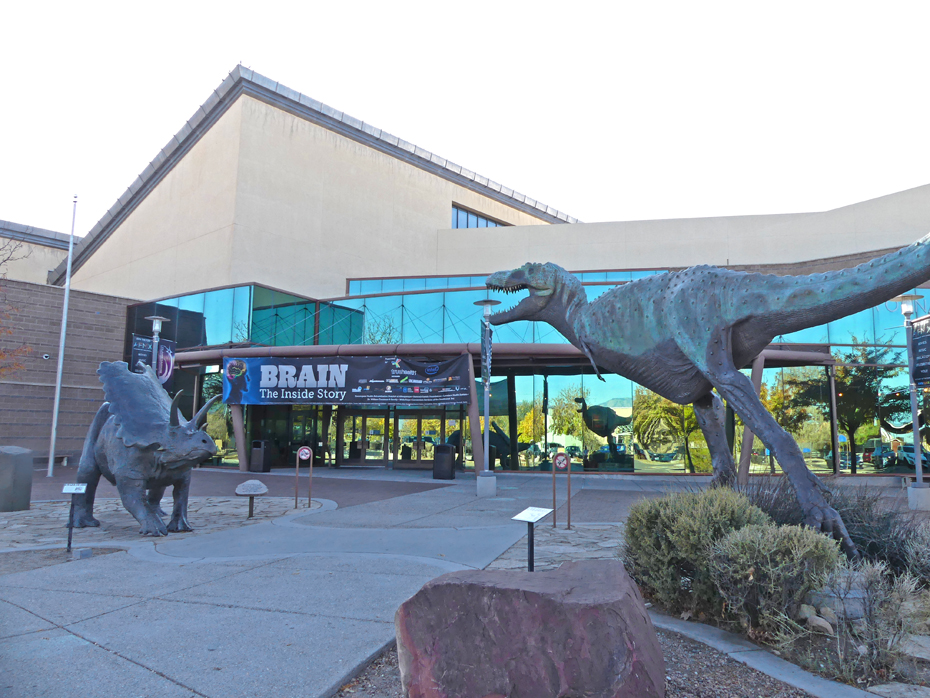
Travel farther back in history to
prehistoric New Mexico? You can at
New Mexico Museum of
Natural History and Science
where you're greeted out
front by Alberta and Spike, their resident dinosaurs. No, they
are not real but they are impressive sculptures. The museum
tells New Mexico's story in varied ways from how the first
multi-cellular life began to the space age. One impressive
exhibit deals with climate change; how it's happening and its
causes and results.
.JPG)
Learn Native American history and culture
at
The Indian Pueblo Cultural Center.
Here you
are stepping into another time and place. You are now on Native
American lands. Indians from 19 nearby pueblos perform the
traditional dances that tell stories handed down through the
ages. It's a
magical blend of dance, costume, chant, and well woven words
that tell the story of their beliefs and culture handed down
through generations.
In the museum the exhibits tell of New
Mexico's Native Americans from earliest pictograms to notable
modern-day tribal members.
.JPG)
Move to modern times at the
National Museum of Nuclear Science and History
where
you're greeted by "Pioneers of the Atom" exhibit. The museum
traces nuclear history from the first splitting of an atom to
today's uses of nuclear power. There's an exhibit showing
operations at Las Alamos and a model of "Fat Man," the bomb
dropped on Nagasaki, Japan.
Children will enjoy learning while having
fun in the Children's Section. Outside there's an display of
bombs and the planes that dropped them.
.JPG)
The Albuquerque Museum of Art and
History
is as all about the story of Albuquerque as
well as displaying painting and sculptures. Naturally, it has
traditional art but there's a lot more. From the culture of the
Tiwa people who once lived in what is now Albuquerque to the
city's contribution to the atomic age, you will find it here.
.JPG)
Old Town
takes you back to
Albuquerque's distant past with shops, a plaza and more.
.jpg)
There's so much more including a terriffic botanical
garden, an aquaerium , and a zoo.
Public /span>
Disclosure Please Read FTC has a law
requiring web sites to let their readers know if any of the
stories are 'sponsored' or compensated. We also are to
let readers know if any of our links are ads. Most are not.
They are just a way to direct you to more information
about the article where the link is placed. We have several ads
on our pages. They are clearly marked as ads. I think
readers are smart enough to know an ad when they see one but to
obey the letter of the law, I am putting this statement here to
make sure everyone understands. American Roads and Global
Highways may contain affiliate links or ads. Further, as their
bios show, most of the feature writers are professional travel
writers. As such we are frequently invited on press trips, also
called fam trips. On these trips most of our lodging, dining,
admissions fees and often plane fare are covered by the city or
firm hosting the trip. It is an opportunity to visit places we
might not otherwise be able to visit. However, no one tells us
what to write about those places. All opinions are 100% those
of the author of that feature column.
|
Search our site-- end of freefind search box html -->
We'd love to have you follow on social media. please use our hashtag,
#ARGH
|

 |
 |

Pintrest |

Email us
You can order autographed copies of
my books at
KatysWorld.
My newest is
American Music: Born
in the USA.
Available at Amazon.
The
Tenant from Hell
Book 1 in
the Realtor Mystery Series
Casey Clark,
property manager, is
just trying to evict
a bad tenant.
Instead she is over
her head in murder
and mayhem.
Available at Amazon
 |
Double
Duplicity
Book 2 in the Realtor Mystery
Series
Trouble follows
Casey like a raging
fire.
Available at Amazon
|
Missing--
Gone but not Forgotten
Based on the unsolved abduction
of a little girl in a
rural Florida Community.
Available at Amazon
Under
a Bloody Flag
Kansas and Missouri were a "no man's land" in the days before the War between the States.
Available at Amazon
|

Under a Black Flag
Kansas and Missouri heated to the boiling point during the War between the States.
Available at Amazon
|

For
Want of a Ship
John Roy came to New Orleans
looking for peace
instead he found war
Available at Amazon
.
Last Step
Last Step will keep
you on the edge of
your seat and leave
you gasping in
surprise at the
ending.
Available at Amazon
|
Kudzu
Kudzu shows you
a different part of the South, past and present. Mystery with a touch of romance and a smidgen of paranormal.
Available at Amazon
|
Wild about Florida:
South FL
The Everglades swarm
with wildlife from
birds, to mammals,
to reptiles.
Available at Amazon
|

Wild about Florida:
Central FL
Central Florida has
the ocean and gulf
beaches much like
other parts of
Florida but in many
other ways it is
distinct and unique.
Available at Amazon
Wild About Florida:
North FL
Come explore caves,
hills, whitewater
falls and lots of
other fun things you
didn't expect to
find in Florida.
Available at Amazon
|

Georgia's
Ghostly Getaways
Who is not fascinated by
mysterious things
that go bump in the
night? Are
there some places
where departed souls
still linger?
Available at
Amazon
Hosts With
Ghosts
The
South has long been
famous for its
Southern
Hospitality. Hotels
throughout Dixie vie
with one another to
offer their guests
more service and
more amenities.
Many have guests
that never depart.
Available at
Amazon
|
Finding
Florida's Phantoms
Florida! The land of
sunshine and
wide-open beaches.
But even the
Sunshine State has
its dark secrets.
Places where
centuries old
spirits remain tied
to earth. Beneath
the facade of fun
and make believe
lurks the real
Florida.
Available at Amazon
|
Color Saint
Augustine
This is a way to
virtually visit
Saint Augustine.
It's a coloring book
for grown ups (but
kids will love it
too.)
with an actual photo
of the attractions
in Saint Augustine.
The opposite page is
the same photo
converted into a
black and white line
image for you to to
color. It's 64 pages
with 30 photos and
30 pages for you to
color. On each photo
and each color page
there is a little
about the story of
the image . |
|