Experience Medical Practices During the Civil War
Story and photos
by Kathleen Walls
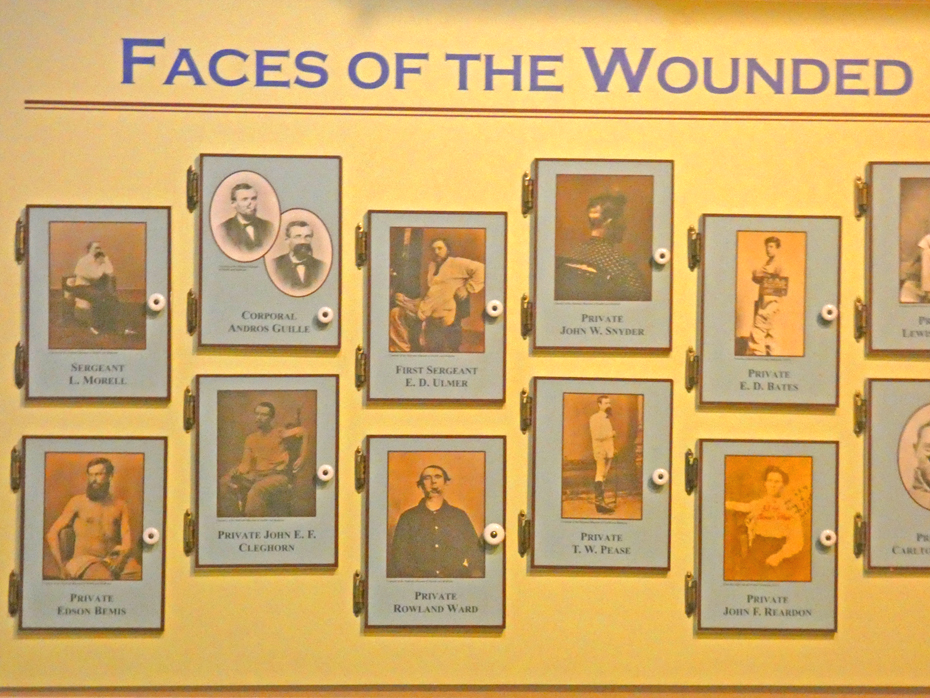
The National Museum of Civil War Medicine
in Frederick, Maryland is a deep dive into what it was like to
be a sick or wounded soldier in the Civil War. In many ways, it
was a horror story, but it showed how doctors then led to modern
medical practices. It dispels the myth that the doctors then
were quacks. Doctors for both the Union and Confederate Army
were educated doctors who had to pass rigorous tests before they
were accepted as surgeons. They followed a scientific approach
to medicine rather than a belief in folklore medicine. This is
one of the most interesting museums I've visited.
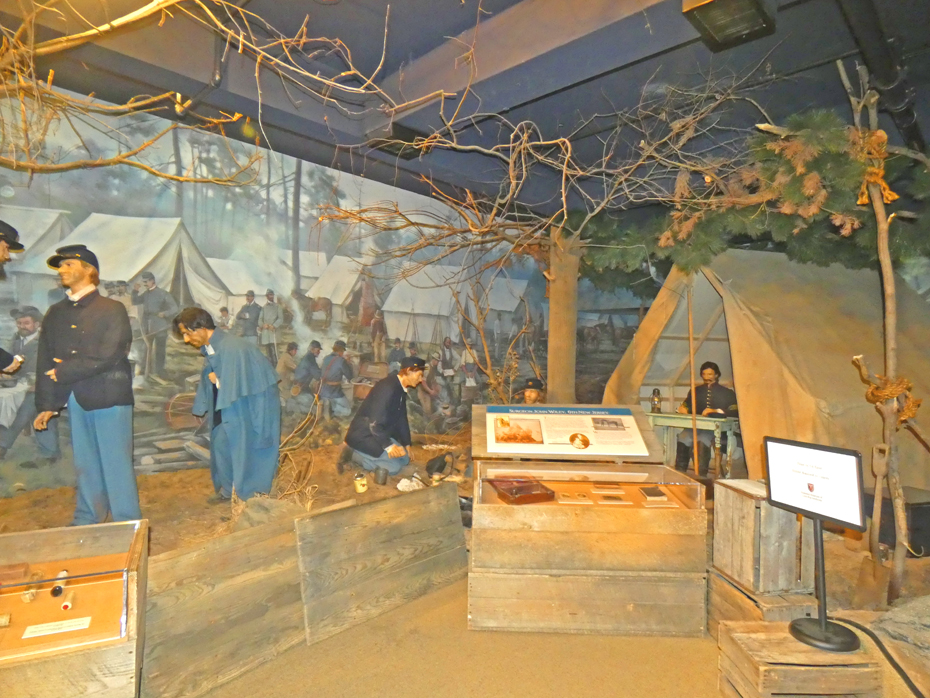
The exhibit of a typical camp shows how
unsanitary conditions led to disease. In the camps, we see all
these men crowded together, living together in conditions that
are conducive to illness and disease. Medical personnel didn't
believe in germs, and more soldiers died from dysentery and
infections than wounds. In many cases amputations resulted from
infections that could have been prevented by simply washing
hands.

Yet, the learning experiences of field
doctors laid the foundation for America's modern medical system.
A surgeon named Jonathan Letterman was appointed medical
director of the Army of the Potomac. He instituted sanitary
reforms like having latrines covered with soil daily and moving
them away from water sources. He has camps set up in a more
orderly fashion where animals are separated from people. The
common belief at the time was that bad air caused disease, but
his measures also improved sanitation and the spread of germs.There
are books about Civil war
medicine at Amazon that tell more about what it was like for
surgeons then..
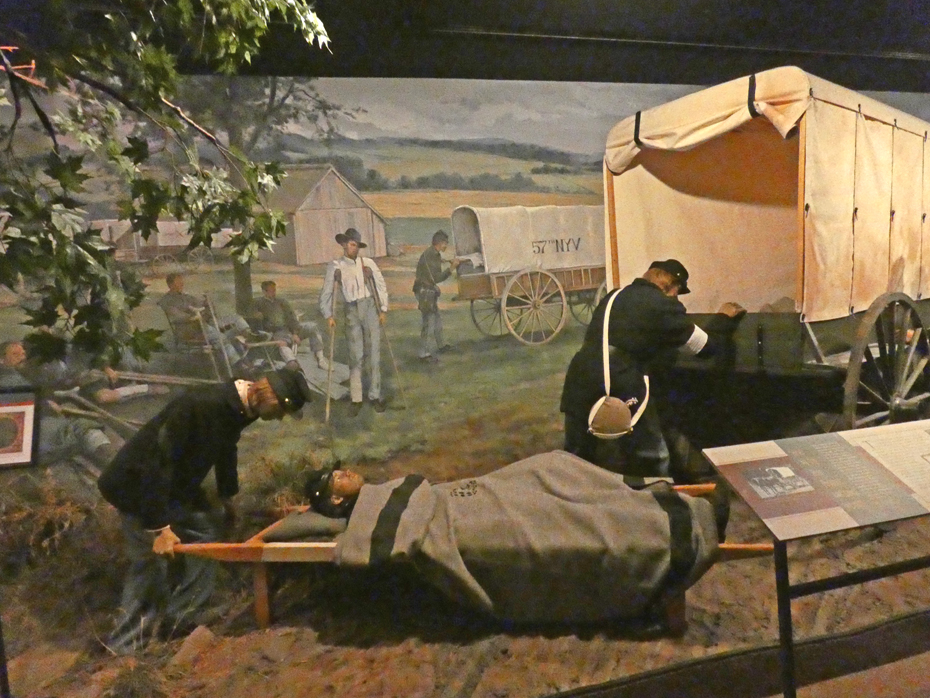
Another exhibit shows a wounded soldier
being loaded into an early ambulance. I never knew there were no
ambulances in the US before the Civil War. Wounded men sometimes
lay on the battlefield for a week. Many of them died in the
fields, because they didn't get help. In August 1862, Letterman
started an ambulance corps in the Army of the Potomac. One of
the first ambulances used by the United States military was a
four-wheeled vehicle that held 6 to 12 wounded men seated, or
four men lying down. The back seats could move.
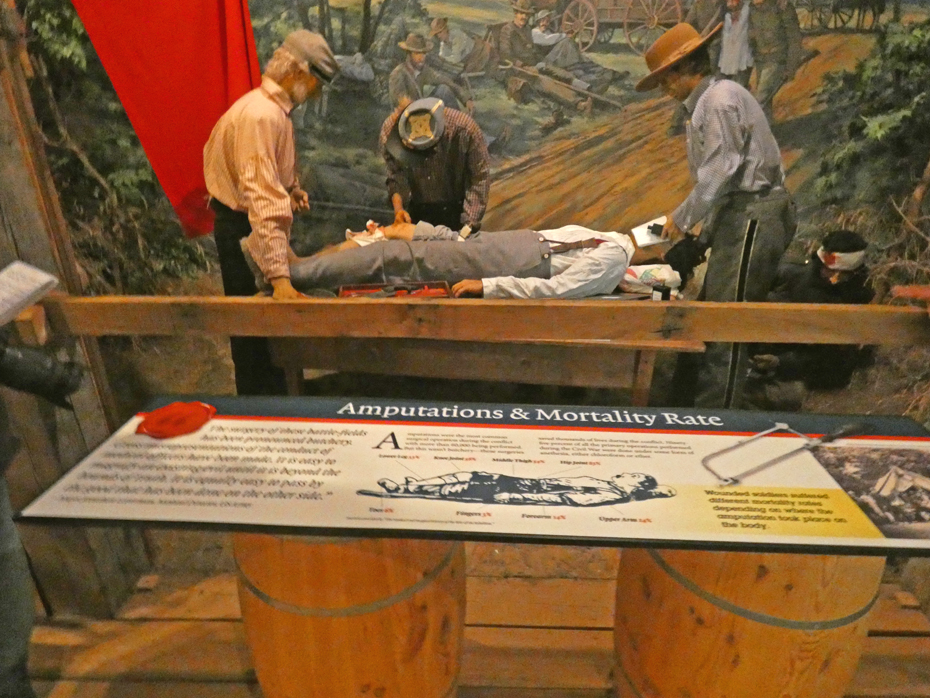
One of the most moving exhibits shows an
amputation with an assistant giving ether. When the doctors
amputated a limb, often gangrene set in and killed many
patients. By about 1863, they learned that carbolic acid cures
gangrene if you inject it or pour it on the infected limb. But
it's extremely caustic, so it will kill good tissue as well.
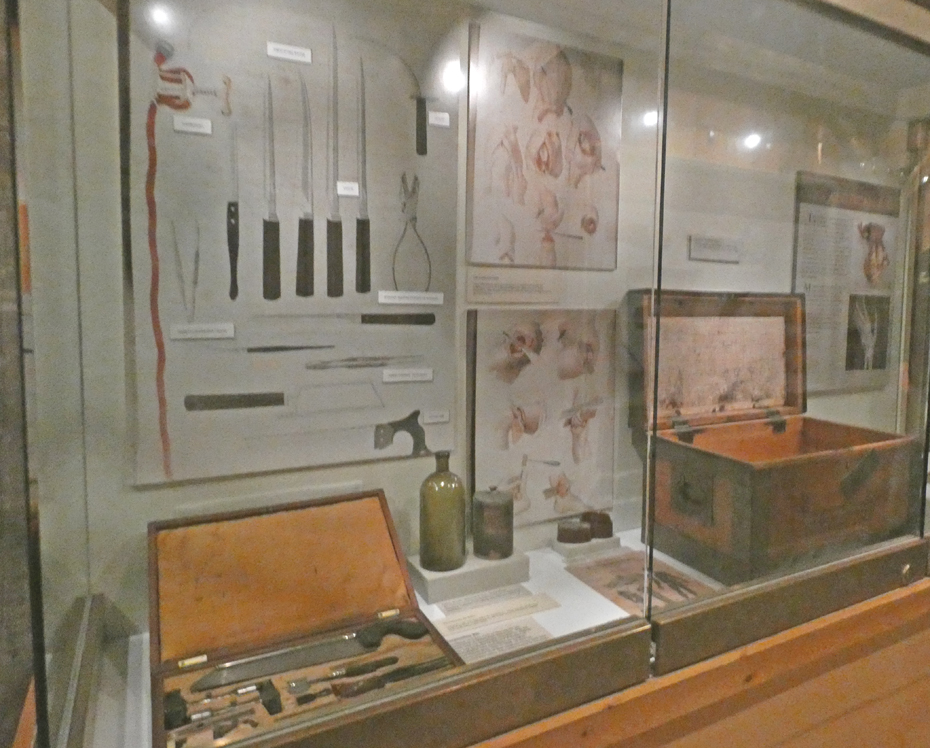
Soon, Middleton Goldsmith, a Union surgeon
in Tennessee, begins spraying a mineral called bromine into the
air, because it smelled clean. Remember all of them believed bad
smells spread disease. Soon, he noticed in his ward that he had
fewer cases of gangrene, and the ones that he had were not very
severe. Goldsmith realized the only thing he was doing
differently than everyone else was spraying the bromine.
He
injected bromine liquid into the gangrenous wound of a soldier
three days a week, and it cured the gangrene. He didnn't know
why, but it's not caustic. It doesn't burn good tissue like the
other stuff. So he tells the other surgeons at this hospital.
When this works, he wrote a report, sent it to the Surgeon
General's office, and they accepted it and recommended bromine
use. In the North, gangrenous deaths dropped from 30 and 40% to
4% by the end of the war.
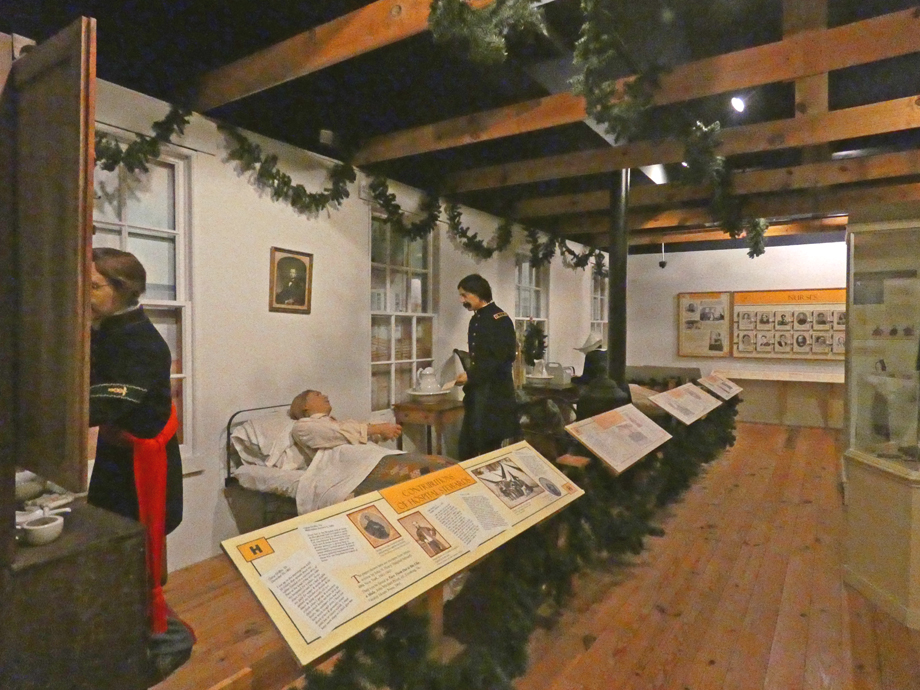
The museum tells of not only field
hospitals but the city hospitals for military. During the Civil
War, the Confederacy's largest hospital, Chimborazo Hospital,
was in Richmond, Virginia. Today, the site is home to Chimborazo
Park and the Chimborazo Medical Museum. For the Union, DC and
Philadelphia had large hospital centers as well. Philadelphia
had Satterlee Hospital where Clark Park is today.
This
is just a touch of what you will see there. There is so much
more you need to go see for yourself. The museum offers
self-guided tours, or if you have a group of 20 or more you can
book a guided tour.
Public
Disclosure Please Read FTC has a law
requiring web sites to let their readers know if any of the
stories are 'sponsored' or compensated. We also are to
let readers know if any of our links are ads. Most are not.
They are just a way to direct you to more information
about the article where the link is placed. We have several ads
on our pages. They are clearly marked as ads. I think
readers are smart enough to know an ad when they see one but to
obey the letter of the law, I am putting this statement here to
make sure everyone understands. American Roads and Global
Highways may contain affiliate links or ads. Further, as their
bios show, most of the feature writers are professional travel
writers. As such we are frequently invited on press trips, also
called fam trips. On these trips most of our lodging, dining,
admissions fees and often plane fare are covered by the city or
firm hosting the trip. It is an opportunity to visit places we
might not otherwise be able to visit. However, no one tells us
what to write about those places. All opinions are 100% those
of the author of that feature column.
|
Search our site
We'd love to have you follow on social media. please use our hashtag,
#ARGH
|

 < <
 |

Pintrest |

Email us
You can order autographed copies of
my books at
KatysWorld.
My newest is
American Music: Born
in the USA.
Available at Amazon.

The
Tenant from Hell
Book 1 in
the Realtor Mystery Series
Casey Clark,
property manager, is
just trying to evict
a bad tenant.
Instead she is over
her head in murder
and mayhem.
Available at Amazon
 |
Double
Duplicity
Book 2 in the Realtor Mystery
Series
Trouble follows
Casey like a raging
fire.
Available at
Amazon
|
Missing--
Gone but not Forgotten
Based on the unsolved abduction
of a little girl in a
rural Florida Community.
Available at Amazon
Under
a Bloody Flag
Kansas and Missouri were a "no man's land" in the days before the War between the States.
Available at Amazon
|

Under a Black Flag
Kansas and Missouri heated to the boiling point during the War between the States.
Available at Amazon |

For
Want of a Ship
John Roy came to New Orleans
looking for peace
instead he found war.
Last Step
Last Step will keep
you on the edge of
your seat and leave
you gasping in
surprise at the
ending. |
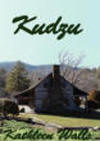
Kudzu
Kudzu shows you
a different part of the South, past and present. Mystery with a touch of romance and a smidgen of paranormal. |
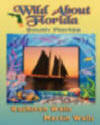
Wild about Florida:
South FL
The Everglades swarm
with wildlife from
birds, to mammals,
to reptiles.
|

Wild about Florida:
Central FL
Central Florida has
the ocean and gulf
beaches much like
other parts of
Florida but in many
other ways it is
distinct and unique.
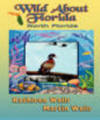
Wild About Florida:
North FL
Come explore caves,
hills, whitewater
falls and lots of
other fun things you
didn't expect to
find in Florida.
|

Georgia's
Ghostly Getaways
Who is not fascinated by
mysterious things
that go bump in the
night? Are
there some places
where departed souls
still linger?
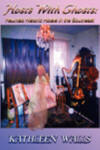
Hosts With
Ghosts
The
South has long been
famous for its
Southern
Hospitality. Hotels
throughout Dixie vie
with one another to
offer their guests
more service and
more amenities.
Many have guests
that never depart.
|
Finding
Florida's Phantoms
Florida! The land of
sunshine and
wide-open beaches.
But even the
Sunshine State has
its dark secrets.
Places where
centuries old
spirits remain tied
to earth. Beneath
the facade of fun
and make believe
lurks the real
Florida.
|
Color Saint
Augustine
This is a way to
virtually visit
Saint Augustine.
It's a coloring book
for grown ups (but
kids will love it
too.)
with an actual photo
of the attractions
in Saint Augustine.
The opposite page is
the same photo
converted into a
black and white line
image for you to to
color. It's 64 pages
with 30 photos and
30 pages for you to
color. On each photo
and each color page
there is a little
about the story of
the image . |
|
|
|
|
|
|
/td>
| |